Dolphin SuperSockets
Fast Sockets
A PCI Express® network can replace local Ethernet networks with a higher speed lower laten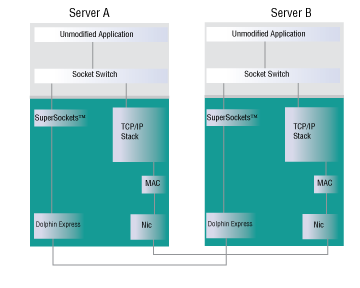 cy network. The combination of Dolphin’s PCI Express® hardware and Dolphin’s SuperSockets™ delivers maximum application performance without necessitating application changes. SuperSockets™ is a unique implementation of the Berkeley Sockets API that capitalizes on the PCI Express® transport to transparently achieve performance gains for existing socket-based network applications. Dolphin Express hardware and the SuperSockets™ software layer create an ultra-low latency, high-bandwidth, low overhead, and high availability platform to support the most demanding sockets based applications. With support for both Linux and Windows Operating systems, new and existing applications can easily be deployed on a high performance PCI Express® network without any modifications.
This page describes the Linux version. Consult these pages for SuperSockets on Windows.
Key Product Features
- Compliant with Linux Socket library and Berkeley Sockets
- All popular Linux distributions supported
- Both TCP and UDP support
- UDP multicast support
- Supports both user space and kernel space clients
- Full support for socket inheritance/duplication
- Transparent fail-over to Ethernet if high speed connection is down. Fail forward when problem is corrected
- Includes local loopback socket acceleration up to 10 times faster than standard Linux loopback device
- Supports multiple adapters per host for increased fault tolerance and speed
- No OS patches or application modifications required
- Easy to install with no application modifications
- Includes local loopback socket acceleraton up to 10 times faster than standard Linux
Availability
SuperSockets is available for all popular Linux 2.6 - 4.x distributions and kernels for Intel and AMD x86 and x64 systems (32 and 64 bit installations).
Installation
All software are provided as rpm or deb packages for Linux. An installation scrip enables automatic cluster wide installation on all nodes. More details can be found in the download and installation guides section.
Low latency - Sockets
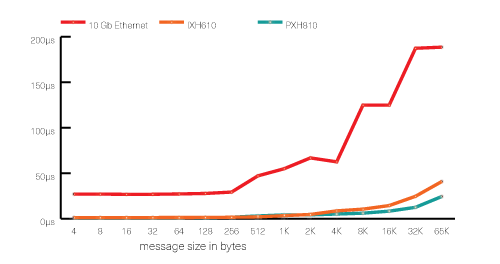
The latency_bench benchmark shows that a complete 1 byte socket send - socket receive is completed in 0.99 us (Full round-trip in 2 us). This is typically 10x times better than regular 10Gigabit Ethernet.
High Througput - Sockets
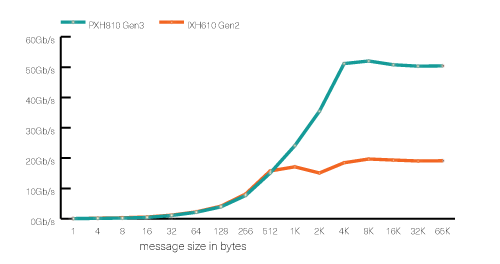
Benchmarks using iperf shows more than 50 Gbit/s throughput using standard TCP_STREAM sockets over one single PXH adapter card running in PCI Express x8 Gen3 configuration.